SERVICE 03 · OFF-GRID · SHEET 04
Off-Grid Solar Installation for Kelowna Properties
For cabins, shops, wells and rural lots where running a power line costs more than generating your own. Designed around the darkest weeks of the year, because that is when off-grid systems fail.
OVERVIEW
Off-grid starts with a load list, not a panel count
Off-grid solar installation near Kelowna is a different job from a grid-tied roof. There is no FortisBC bank to fall back on, so the system has to cover your worst week of the year by itself, with the battery and a generator doing the work when the panels can’t.
We start with a list of everything you want to run and for how long: lights, a fridge, a well pump, tools in the shop, a furnace fan. From that we size the battery for the number of cloudy days you want to ride through, the array for December sun, and the generator for the rest. Then we price it against the cost of bringing in a line, so you can choose with both numbers in front of you.
Call 250-250-2525 with a rough list of what you want to run.

SPEC SHEET
Off-Grid Solar Installation at a glance
- Typical size
- 2–6 kW cabins and shops; 8–15 kW full-time homes
- Batteries
- Lithium iron phosphate, kept above freezing, sized in days of autonomy
- Backup
- Auto-start generator for long cloudy spells
- Mounting
- Steep ground mounts (50–60°) for winter sun and snow shedding
- Permits
- Technical Safety BC electrical permit
- Monitoring
- Remote battery and generator monitoring where there is signal
INCLUDED
What an off-grid installation includes
- 01
Load list and winter design
Sized for December, with the generator hours shown up front.
- 02
Line-extension comparison
We compare a stand-alone system with the cost of bringing in a line.
- 03
Battery room
Ventilated, insulated, above freezing, with clear access.
- 04
Ground mount or roof
Steep ground mounts where snow and low sun matter most.
- 05
Generator integration
Auto-start, sized to recharge the bank in a sensible run time.
- 06
Training
A walk-through of the system and what to do when the battery runs low.
PRICE
What off-grid systems cost
| System | Typical installed price | What it runs |
|---|---|---|
| Cabin or shop | $9,000 – $18,000 | Lights, fridge, tools, pump, weekend use |
| Year-round small home | $30,000 – $45,000 | Efficient home with propane or wood heat |
| Full-time family home | $45,000 – $60,000+ | All loads, generator for the darkest weeks |
Typical ranges, not quotes. Batteries are the largest single cost and are not PST-exempt; panels are. No utility rebates apply to off-grid systems.
DESIGN FOR DECEMBER
Sizing an off-grid system for a Kelowna winter
A cabin load worked through, to show the method. Your numbers will differ.
| Step | Example: weekend cabin | Why |
|---|---|---|
| Daily load | 3.5 kWh (fridge, lights, pump, devices) | Everything starts here |
| Days of autonomy | 3 cloudy days | Valley inversion weeks in December |
| Battery | ≈ 13 kWh usable | 3.5 kWh × 3 days, plus margin |
| Array | ≈ 3 kW at 55–60° tilt | December sun is low and short |
| Generator | ≈ 30–60 hours a winter | Covers the longest dark spells |
Illustrative. We size every system from your own load list.
WINTER
Snow, cold and lithium batteries
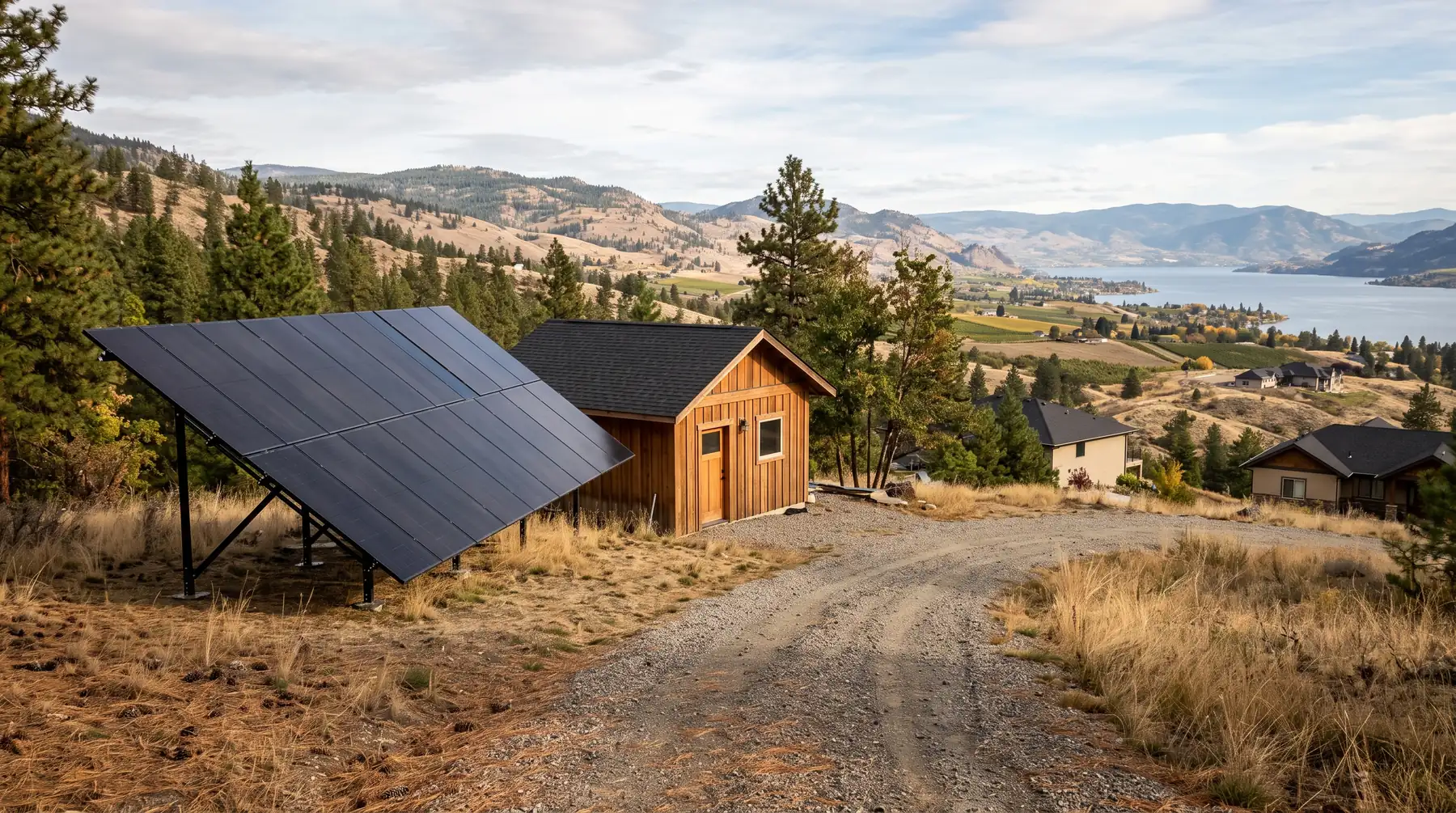
Panels shed snow fastest when they are steep, so off-grid ground mounts go in at 50–60°, not the 20–30° of a house roof. That also faces them toward the low winter sun.
Lithium batteries can’t charge below freezing, so the battery space is insulated and kept warm, or the batteries carry built-in heaters. We plan that space as part of the job.

TIMELINE
From first visit to switch-on
Off-grid systems skip the FortisBC steps entirely, so they usually finish in four to six weeks. The permit and inspection still apply.
Timeline as a table
| Step | Who | Weeks | What happens |
|---|---|---|---|
| Assessment | You + us | 0–1 | Bills, roof, panel box, shade. Usually one visit or a video call. |
| Design & written quote | Us | 1–2 | Panel layout, single-line drawing, price, timeline and payback in writing. |
| FortisBC application | FortisBC | 2–5 | Net-metering application; FortisBC reviews it and approves construction. |
| Permits | Us | 3–5 | Technical Safety BC electrical permit; a City of Kelowna building permit if structural work is involved. |
| Install days | Crew | 5–6 | Usually 1–3 days on site for a home: mounts, rails, modules, inverter, wiring. |
| Inspection | Inspector | 6–7 | Electrical inspection of the finished work under the permit. |
| Interconnection & switch-on | FortisBC + you | 7–9 | Interconnection Agreement signed, meter set for net metering, system commissioned. |
QUESTIONS
Questions about off-grid
Q01How much roof space do I need?
Each modern panel is about 2 square metres and 400–450 watts. An 8 kW system needs about 18 panels, or roughly 36 square metres (390 square feet) of usable roof, ideally facing south, south-west or west.
Q02Can I add a battery later?
Yes. Many people start with panels and add a battery later. If backup is likely, we choose an inverter that makes adding one simpler and cheaper.
AREAS
Where we install
Off-Grid Solar Installation across Kelowna, including:
OTHER SERVICES
Also installed
-
01
Residential Solar InstallationPanels on your house, sized to a year of bills and connected to FortisBC.
Size5–12 kWOn site1–3 daysUtility stepFortisBC net metering

-
02
Business & Farm Solar InstallationRoof or ground arrays for shops, offices, wineries, orchards and strata.
Size15–50 kWOn site3–10 daysUtility stepFortisBC, 50 kW cap

-
04
Battery Backup InstallationBatteries and backup panels that keep chosen circuits on in an outage.
Size10–30 kWhOn site1–2 daysUtility stepFortisBC review if paired with solar

-
05
Solar Repair, Maintenance & Re-InstallationDiagnostics, repairs, cleaning and remove-and-reinstall for re-roofing.
Visit1–3 hoursRe-install1–3 daysUtility stepUsually none

WORK ORDER № SIK-013
Start with a free assessment
Tell us where the property is and what you’re after. We reply within one business day with next steps, or a straight answer if solar doesn’t suit it.
OR CALL250-250-2525
- A year of FortisBC bills helps most
- A photo of your electrical panel, door open
- Plans for an EV, heat pump or pool