SERVICE 02 · BUSINESS & FARM · SHEET 03
Business & Farm Solar Installation in Kelowna
Shops, offices, wineries, orchards and strata buildings use most of their power in daylight. We size the system to that load and to FortisBC’s rules, then install it without shutting you down.
OVERVIEW
Daytime load is the advantage
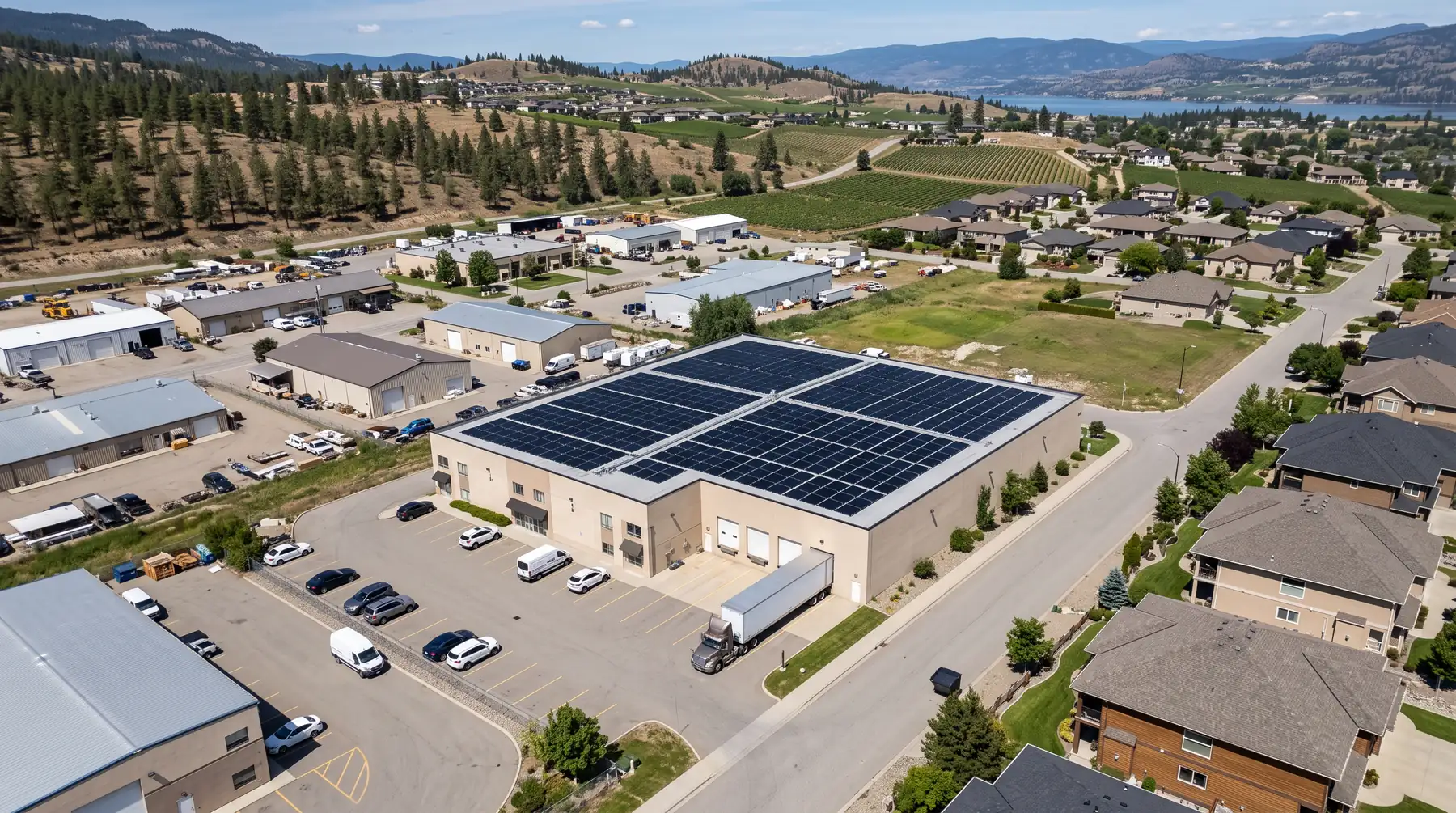
A business uses most of its electricity while the sun is up: lights, compressors, cooling, irrigation, kitchen equipment. That makes solar on a commercial roof in Kelowna work harder than the same panels on a house, because more of the output is used the moment it is made.
FortisBC’s net-metering program covers commercial and irrigation accounts up to 50 kW per account. That is roughly 110 panels and enough for most shops, clinics, small wineries and packing sheds. We size to your load profile, not to the size of the roof, so the system doesn’t build up a surplus that only earns FortisBC’s low annual settlement rate.
Call 250-250-2525 to talk through your bills and roof.

SPEC SHEET
Business & Farm Solar Installation at a glance
- Typical size
- 15–50 kW per FortisBC account
- Time on site
- 3–10 days, scheduled around your hours
- Structure
- Ballasted or attached roof racking, or ground mounts on posts
- Utility step
- FortisBC net metering (commercial and irrigation accounts, up to 50 kW)
- Tax
- Ask your accountant about the federal Clean Technology Investment Tax Credit
- Monitoring
- Production monitoring by array, with alerts
INCLUDED
What a business or farm project includes
- 01
Load review
Twelve months of interval or billing data, matched to when you actually use power.
- 02
Structural check
Roof capacity and snow load for rooftop arrays; soil and post design for ground mounts.
- 03
Landlord and strata packages
Drawings, specifications and letters for owners, councils and insurers.
- 04
Utility and permits
FortisBC application, electrical permit, and City permits where needed.
- 05
Out-of-hours installation
Work planned around trading hours, harvest and guests.
- 06
Handover
Monitoring, single-line drawing and maintenance schedule for your facilities team.
PRICE
Commercial and farm installation costs
| System | Typical installed price | Year-one value on FortisBC | Where it fits |
|---|---|---|---|
| 15 kW | $36,000 – $44,000 | ~$2,800 | Shop, small office, packing shed |
| 25 kW | $55,000 – $66,000 | ~$4,650 | Winery production building, clinic |
| 50 kW | $105,000 – $130,000 | ~$9,300 | Warehouse, cold storage, the FortisBC cap |
Typical ranges, not quotes. Larger systems cost less per watt (about $2.10–$2.60/W). Value assumes every kWh offsets about 15.5¢; commercial rate schedules differ, so we model your actual bill.
UTILITY LIMITS
FortisBC’s cap shapes a business system
| FortisBC (all of Kelowna) | BC Hydro (westside) | |
|---|---|---|
| Maximum size | 50 kW per account | Up to 300 kW (100 kW per phase) |
| Exports | Banked as kWh, settled yearly at a low rate | Flat 10¢/kWh on each bill |
| Rebate | None | Up to $10,000 for commercial accounts |
| Accounts | Commercial and irrigation accounts eligible | General Service accounts |
As of October 2026. Businesses may also qualify for the federal Clean Technology Investment Tax Credit (up to 30% of eligible costs); ask your accountant.
ROOF OR GROUND
Roof or ground mount?
Flat commercial roofs take ballasted racking that sits on the membrane with few or no penetrations, after a structural check. Metal shop and barn roofs take clamp-on mounts with no drilling at all.
On farms and wineries, a ground mount can face due south at the ideal tilt and stay clear of the roof entirely. It costs more for posts and trenching, and it needs a sensible spot that doesn’t take good growing ground.

TIMELINE
From first visit to switch-on
The usual sequence for a Kelowna installation. Your written plan carries real dates.
Timeline as a table
| Step | Who | Weeks | What happens |
|---|---|---|---|
| Assessment | You + us | 0–1 | Bills, roof, panel box, shade. Usually one visit or a video call. |
| Design & written quote | Us | 1–2 | Panel layout, single-line drawing, price, timeline and payback in writing. |
| FortisBC application | FortisBC | 2–5 | Net-metering application; FortisBC reviews it and approves construction. |
| Permits | Us | 3–5 | Technical Safety BC electrical permit; a City of Kelowna building permit if structural work is involved. |
| Install days | Crew | 5–6 | Usually 1–3 days on site for a home: mounts, rails, modules, inverter, wiring. |
| Inspection | Inspector | 6–7 | Electrical inspection of the finished work under the permit. |
| Interconnection & switch-on | FortisBC + you | 7–9 | Interconnection Agreement signed, meter set for net metering, system commissioned. |
QUESTIONS
Questions about business & farm
Q01How does FortisBC net metering work?
FortisBC’s net-metering program covers residential, commercial and irrigation customers with renewable generation on their own property, up to 50 kW. The system should be sized to your expected yearly use.
When you make more than you use in a billing period, the surplus is banked as kWh credit and used in later periods. Anything left at the end of the year is settled once, at the much lower rate FortisBC pays other power producers. That is why we size to your annual use and not to the size of the roof.
Q02Am I on FortisBC or BC Hydro?
Check the name at the top of your electricity bill. Every neighbourhood in the City of Kelowna, including central Kelowna’s old City-run utility area, is served by FortisBC. Across the bridge, West Kelowna, Westbank and Peachland are mostly BC Hydro.
Q03Is solar worth it in BC?
For a Kelowna home on FortisBC with a decent south, west or east roof, usually yes. An 8 kW system costs about $23,200, saves about $1,490 in year one, pays back around year 14 and saves roughly $50,000 over 25 years. It is a long-term investment rather than a quick one, and we tell you plainly when a roof isn’t worth it.
AREAS
Where we install
Business & Farm Solar Installation across Kelowna, including:
OTHER SERVICES
Also installed
-
01
Residential Solar InstallationPanels on your house, sized to a year of bills and connected to FortisBC.
Size5–12 kWOn site1–3 daysUtility stepFortisBC net metering

-
03
Off-Grid Solar InstallationStand-alone solar, batteries and backup generation for places without a line.
Size2–15 kWOn site2–5 daysUtility stepNone

-
04
Battery Backup InstallationBatteries and backup panels that keep chosen circuits on in an outage.
Size10–30 kWhOn site1–2 daysUtility stepFortisBC review if paired with solar

-
05
Solar Repair, Maintenance & Re-InstallationDiagnostics, repairs, cleaning and remove-and-reinstall for re-roofing.
Visit1–3 hoursRe-install1–3 daysUtility stepUsually none

WORK ORDER № SIK-012
Start with a free assessment
Tell us where the property is and what you’re after. We reply within one business day with next steps, or a straight answer if solar doesn’t suit it.
OR CALL250-250-2525
- A year of FortisBC bills helps most
- A photo of your electrical panel, door open
- Plans for an EV, heat pump or pool