GUIDE — PROCESS
How Solar Installation Works in Kelowna
Seven steps, about six to ten weeks, and only a couple of days on your roof. Here is who does what, and when.
OVERVIEW
The whole job on one chart
A solar installation is mostly a sequence of approvals with a short burst of building in the middle. Knowing the order helps you plan, and it helps you spot a quote that skips a step.
The timeline below is typical for a Kelowna home on FortisBC. Business systems take longer on site; off-grid systems skip the FortisBC steps entirely.
Timeline as a table
| Step | Who | Weeks | What happens |
|---|---|---|---|
| Assessment | You + us | 0–1 | Bills, roof, panel box, shade. Usually one visit or a video call. |
| Design & written quote | Us | 1–2 | Panel layout, single-line drawing, price, timeline and payback in writing. |
| FortisBC application | FortisBC | 2–5 | Net-metering application; FortisBC reviews it and approves construction. |
| Permits | Us | 3–5 | Technical Safety BC electrical permit; a City of Kelowna building permit if structural work is involved. |
| Install days | Crew | 5–6 | Usually 1–3 days on site for a home: mounts, rails, modules, inverter, wiring. |
| Inspection | Inspector | 6–7 | Electrical inspection of the finished work under the permit. |
| Interconnection & switch-on | FortisBC + you | 7–9 | Interconnection Agreement signed, meter set for net metering, system commissioned. |
STEP BY STEP
The seven steps
STEP 01 · Week 0–1 · You + us
Assessment
We look at a year of FortisBC bills, the roof planes, pitch and direction, shade through the seasons, and the electrical panel. Often this is one visit; sometimes a video call and satellite imagery are enough. You leave knowing whether solar is worth pursuing on your property.
YOU SIGN Nothing yet.
STEP 02 · Week 1–2 · Us
Design and written quote
We size the system to your yearly use, draw the panel layout, choose the inverter and racking, and write down the price, the timeline and the payback. You see exactly what goes where, and how it looks from the street.
YOU SIGN The quote and contract, once you are happy.
STEP 03 · Week 2–5 · FortisBC
FortisBC application
We submit the net-metering application with the system details. FortisBC reviews it and sends approval to build. This is usually the longest wait, and nothing goes on your roof until it arrives.
YOU SIGN Sometimes an application form, which we fill in for you.
STEP 04 · Week 3–5 · Us
Permits
Our licensed electrical contractor pulls the Technical Safety BC electrical permit. If the job involves structural work, we check whether a City of Kelowna building permit is needed and apply for it.
YOU SIGN Nothing.
STEP 05 · Week 5–6 · Crew
Installation days
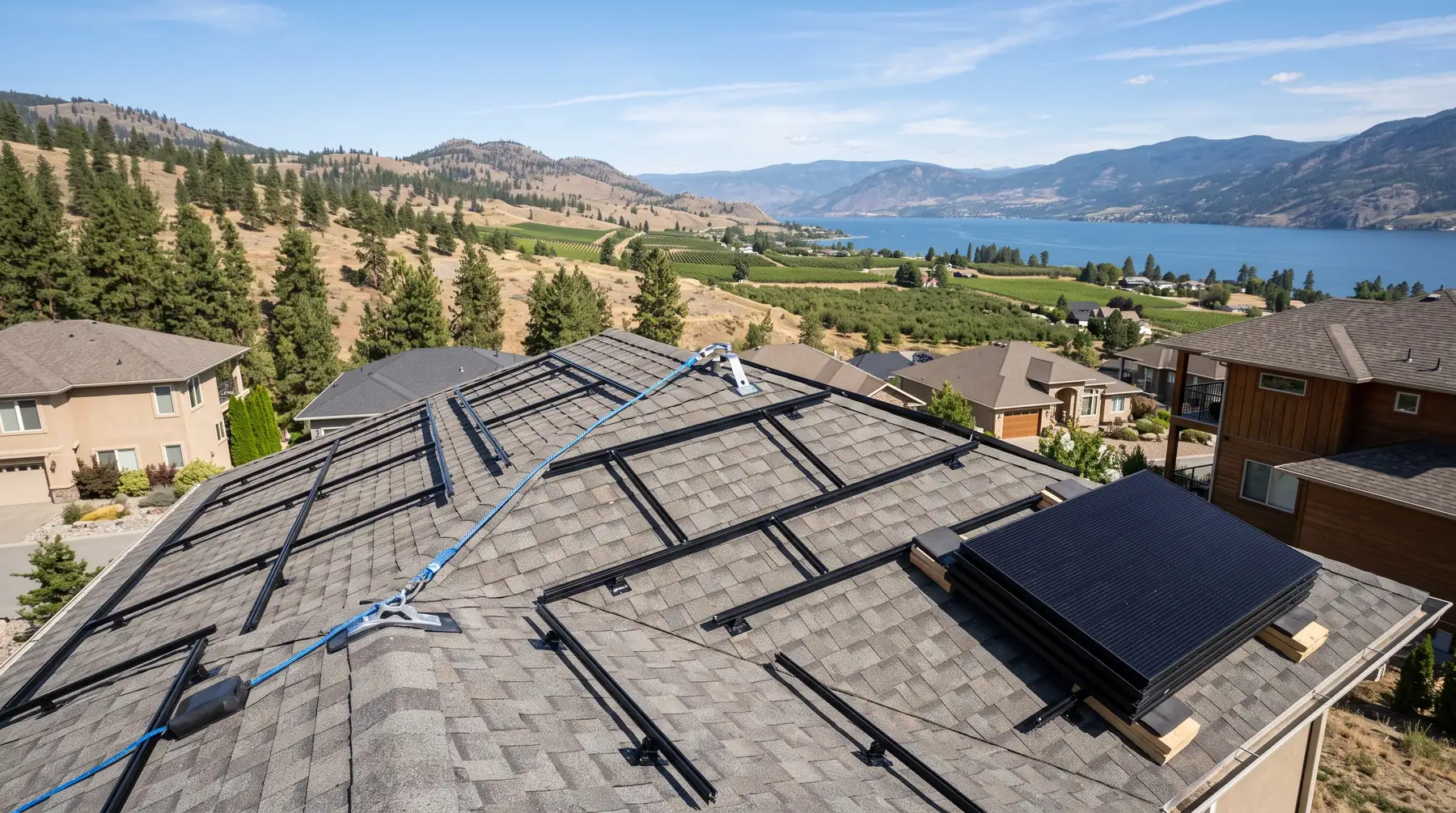
Day one is usually mounts and rails: flashed attachments bolted into rafters, then rails across the roof. Day two, modules, wiring and the inverter. A short power shut-off near the end lets the electrician land the solar breaker. Most homes take one to three days.
YOU SIGN Nothing; we walk you through the finished work.
STEP 06 · Week 6–7 · Inspector
Inspection
The electrical work is inspected under the permit. We arrange it and are there for it.
YOU SIGN Nothing.
STEP 07 · Week 7–9 · FortisBC + you
Interconnection and switch-on
You and the contractor sign FortisBC’s Interconnection Agreement. FortisBC sets the meter for net metering, and we commission the system, set up monitoring and hand over your folder of documents and photos.
YOU SIGN The Interconnection Agreement.
ANATOMY
What gets installed
Every installation has the same ten parts between the sun and the grid. A good quote names each of them: the panel model, the inverter, the racking and how it attaches, the wiring route, the disconnect, the panel-box work and the meter change.
If a quote just says “8 kW solar system, $X”, ask for the rest in writing.
- 1Solar modulesAll-black 400–450 W panels, sized and laid out to your use.
- 2Rails & clampsAluminium rails that hold the modules a few centimetres off the roof.
- 3Mounts & flashingLag-bolted into rafters with flashing under the shingle or a tile hook.
- 4Roof deckChecked before anything goes on it. Old shingles get replaced first.
- 5Conduit runWiring from the array to the inverter, strapped and sealed.
- 6InverterTurns the panels’ DC into AC your home uses.
- 7DisconnectA lockable switch so crews can isolate the system.
- 8Panel boxThe solar breaker lands here. Older 100 A panels may need an upgrade.
- 9Bidirectional meterSet by FortisBC to count power both ways for net metering.
- 10GridFortisBC’s lines, which bank your surplus as kWh credit.
Permits and inspection in Kelowna
Every grid-tied solar installation in BC needs an electrical installation permit from Technical Safety BC. The licensed electrical contractor doing the work pulls it, and the finished work is inspected under that permit. The permit is the reason the electrical side of a solar job must be done by a licensed electrician, whoever does the racking.
Whether you also need a City of Kelowna building permit depends on the job. A standard flush-mounted array on a sound roof is mainly electrical work, but structural changes, such as reinforcing rafters or building a large ground-mount structure, can bring in the building side. We confirm this for each project rather than assume.
Newer Kelowna homes may also have been built solar-hot-water ready, with a marked roof area and a chase from the roof to the mechanical room. It was intended for solar hot water, but the chase can sometimes carry PV wiring and save a run down the outside wall.
Choosing an installer: questions to ask
You don’t need to become a solar expert, but a few questions separate a careful installer from a fast one:
- Who pulls the electrical permit, and who does the electrical work? It should be a licensed electrical contractor, named in the contract.
- Who files the FortisBC application and Interconnection Agreement? The installer should, with you signing where needed.
- How are the mounts flashed? Look for flashing under the shingle above each mount, or proper tile hooks on tile roofs, not just sealant.
- Is a panel upgrade included or excluded? Older 100 A services may need one. It should be in the quote, not discovered later.
- What is the workmanship warranty, in writing? Manufacturer warranties cover the equipment; the installer’s warranty covers leaks and connections.
- How was the system sized? On FortisBC it should be sized to your yearly use. An array much bigger than your use builds a surplus that is settled at a low rate.
- Are you an HPCN member? Essential for BC Hydro’s rebate on the westside; a useful sign of training anywhere.
What installation day looks like
The crew arrives early and sets up fall protection first: roof anchors, harnesses and ropes. Ladders or a lift go up at the eave. Materials are staged in the driveway, and modules stay boxed until they are needed.
Mounts go in first, each one located on a rafter, bolted through and flashed. Rails are fixed to the mounts and levelled, then the modules are clamped on and wired together in strings. On the ground, the electrician mounts the inverter and disconnect, runs conduit up the wall or through the attic, and prepares the panel box. Near the end of the job there is a short planned power shut-off while the solar breaker goes in. The crew cleans up, tests the system and shows you what was done.
The system isn’t switched on for good until the inspection is passed and FortisBC has set the meter. Then it starts producing, and your monitoring app shows output from the first sunny hour.
QUESTIONS
Installation questions
- Q01How long does a solar installation take in Kelowna?
- Q02What permits does a solar installation need in BC?
- Q03Do I need to be home on installation day?
- Q04What is the Home Performance Contractor Network?
- Q05What should a solar quote include?
Q01How long does a solar installation take in Kelowna?
Six to ten weeks from the first visit to switch-on is typical for a home. The work on the roof itself usually takes one to three days; the rest is design, FortisBC approval, the permit and the inspection.
Q02What permits does a solar installation need in BC?
An electrical installation permit from Technical Safety BC, pulled by the licensed electrical contractor, and an inspection of the finished work. A City of Kelowna building permit can also be needed where structural work is involved. FortisBC must approve the connection.
Q03Do I need to be home on installation day?
Not for the whole day. We need access to the electrical panel and the area where the inverter goes, and a short shut-off of your power near the end to connect the system. We agree a time for that in advance.
Q04What is the Home Performance Contractor Network?
A directory of contractors run by the Home Performance Contractor Association. BC Hydro directs its rebate applicants to HPCN members. It matters for BC Hydro customers; FortisBC customers in Kelowna don’t need one for any rebate, because there isn’t one, but it is still a reasonable sign of a contractor’s training.
Q05What should a solar quote include?
System size in kW, panel and inverter models, the number of panels and a layout, racking and mounting method, electrical work including any panel upgrade, permits and utility paperwork, the timeline, the warranties, and the total price with tax shown separately.
WORK ORDER № SIK-009
Get your installation planned
Tell us where the property is and what you’re after. We reply within one business day with next steps, or a straight answer if solar doesn’t suit it.
OR CALL250-250-2525
- A year of FortisBC bills helps most
- A photo of your electrical panel, door open
- Plans for an EV, heat pump or pool